


The Basics of ATV Safety
ATV riding is fun and exhilarating. However, it also has the potential to be dangerous. As such, if you’re going to ride ATVs, you need to know the basics of ATV safety.
Wondering what they are? Then keep on reading. We’re going to review them in detail below.
Wear the Appropriate Safety Gear
ATV riding is a high-impact activity. You’re moving at exceedingly high speeds, and should you fall off your ATV, you’ll be subject to an extremely high-impact collision. As such, you need to wear the appropriate safety gear.
First and foremost, you need a helmet. ATV helmets offer tons of cushion and encase the entirety of the rider’s head. They protect not only the top of the skull but also the face, teeth, and jaws.
You should also wear padded gloves. These are specially designed for ATV purposes and will cushion your hands in the event of a call.
Padded boots are necessary as well. Like gloves, these cushion your body, providing it with a soft landing.
To keep residue out of your eyes, you’re advised to wear goggles also. Goggles will protect you from dirt, sand, stones, and other entities.
Also, make sure to wear pants as opposed to shorts and long sleeves as opposed to short sleeves. Leaving parts of your body exposed can lead to even more serious injury.
Bring a First Aid Kit
Even the mildest of ATV accidents will leave scrapes, cuts, and bruises. As such, you must have a first aid kit on hand. This way, you can patch up small injuries and prevent them from turning into big injuries.
Your first aid kit should contain not only bandages and gauze but ice packs, hydrogen peroxide, and pain medication as well. You can create your own kit, or you can buy one online for a reasonable price.
Strap it to your ATV before you take off, or keep it in a bag and carry it on your back as you ride. Either way, you’ll have quick access to it.
Quit When You’re Fatigued
ATVing is fun, but it’s also exhausting. Moving at high speeds while bumping around and trying to keep your concentration is bound to have your eyes feeling heavy. And if your eyes get too heavy, you could lose concentration, leading to an accident.
As such, when you start to feel fatigued, you should pack it in and go home. Don’t let your fellow riders pressure you into continuing. You know your body, and you know when you might be a danger to yourself.
Anyone who gives you a hard time about this isn’t someone worth riding with. There are plenty of other riding partners in the sea.
Make Sure Your ATV Is in Good Shape
ATVs incur all types of wear and tear. Not only do their tires experience substantial abuse, but so too do their wires, cables, and other components. Driving on a bad component is dangerous and could lead to serious injury.
For this reason, before you take off, you need to inspect your ATV. Make sure that the tires are fully inflated. Ensure that nothing is cracked, and ensure that all of the wires and cables are still in one piece.
Repairing a broken component can be a little expensive. But a little money out of your pocket is a lot better than a life-changing injury.
Only Ride in Designated Areas
There are curated ATV trails all over the place. These trails have been set up as such that they’re as safe as possible. While they’re still relatively rough, they’re designed to keep ATV riders in control of their vehicles.
This isn’t necessarily true of undesignated areas. Riding in the middle of an unmarked field, for instance, could cause you to hit a bump unexpectedly, resulting in a serious and high-impact injury. There’s also a risk of running into unknown waters or cliffs.
Stick to the designated trails, and you’ll give yourself the best chance at a harm-free experience.
Ride With Others
When it comes to ATVing, going it alone is scarcely a good idea. Unless there’s an emergency you’re tending to, it’s always wisest to ride with others.
That way, should you incur a serious injury, there will be others around to help you. Not only will these individuals be able to provide immediate support, but they’ll also be able to call an ambulance for you. This timely support can be the difference between life and death, paralysis, and being able to walk again.
Riding alone, on the other hand, could leave you stranded. You could get injured in the middle of the woods and spend days or even weeks there until someone finds you.
Keep One to a Vehicle
Most ATVs are designed for one person and one person only. Trying to put more than one person on a one-person ATV is just asking for trouble. Not only does it throw off the vehicle’s stability, but it also leaves the person in the back with little to hang onto.
One bad bump and the passenger of the ATV could be catapulted into the air. From there, anything could happen, including severe and life-long injuries.
The only time it would ever be appropriate to put more than one person on an ATV is if the ATV were moving at exceedingly low speeds on exceedingly flat land. We’re talking 10 kilometres per hour.
Get the Size Right
ATVs are available in a variety of sizes, some of which are easier to handle than others. If you want your experience to be as safe as possible, you need to choose an ATV that aligns with your size and capabilities.
Generally speaking, children between the ages of 6 and 10 should use an ATV of 50cc. Children between the ages of 10 and 16 should use an ATV of 90cc. When you’re over the age of 16, you can use ATVs of 250cc and more.
Children under the age of 6 shouldn’t use ATVs at all. They’re far too difficult for small children to operate.
Resist the Urge to Perform Tricks
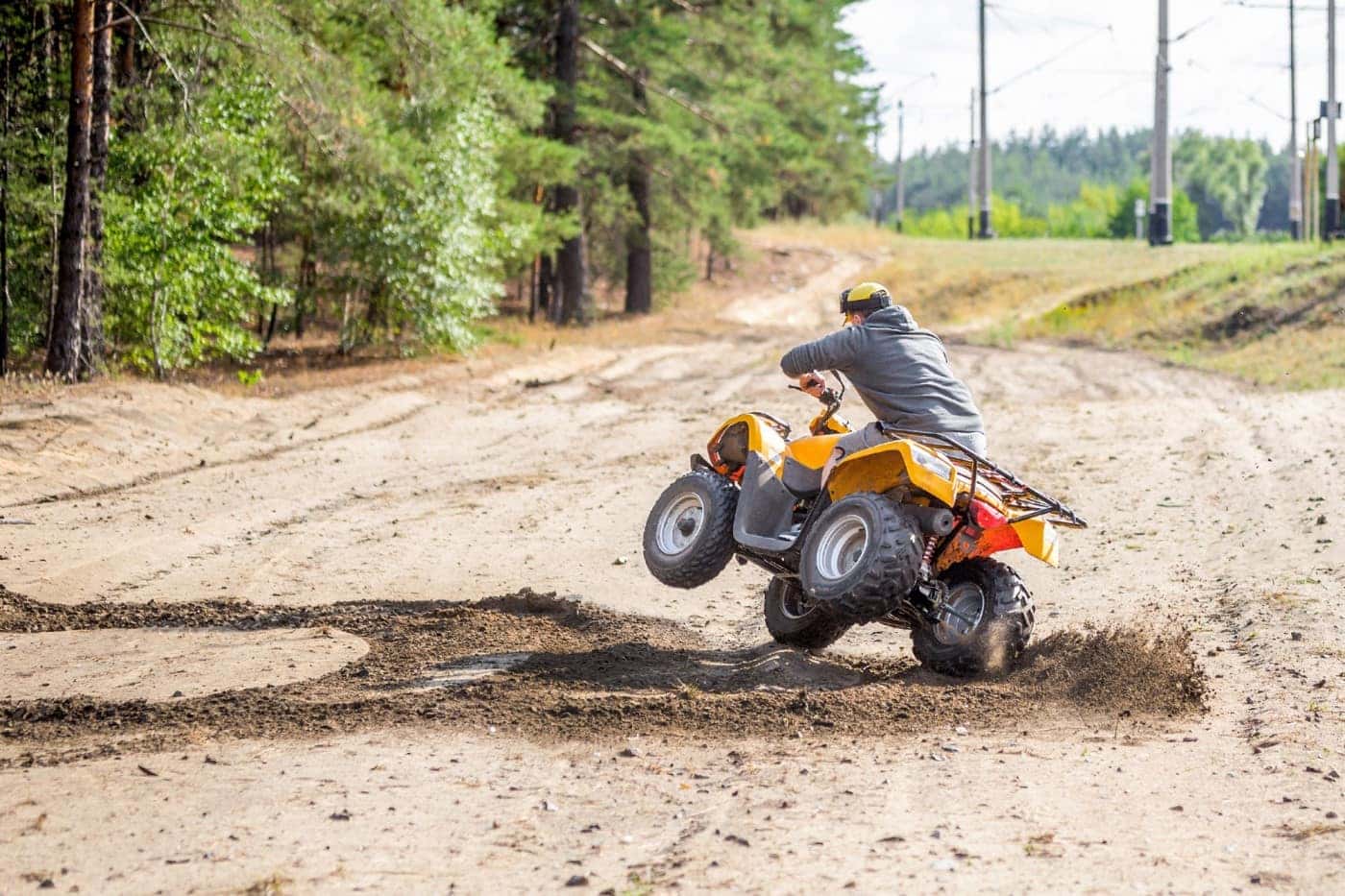
Oftentimes, when a person goes out on an ATV, they feel the need to attempt tricks. For instance, a person may try to ride an ATV on its back wheels only, thrusting its front wheels into the air.
Simply put, this is a bad idea. Performing tricks can be a lot of fun, yes, but they also commonly lead to injury. After all, they come with tons of risk.
For this reason, we suggest avoiding tricks altogether. Unless you have plans to be the next Evel Knievel, they’re not going to do you any good anyway. Keep those wheels on the ground, ride the trail as is, and go home in one piece.
Look Alive
ATVing is a fast-paced activity. You’re moving at high speeds, encountering random elements, and, in many cases, are doing so around fellow ATVers. The risk of an accident is always high.
As such, when you’re riding, you need to look alive. You need to be ever-cognizant of your surroundings and ready to make an emergency maneuver. Making the right maneuver at the right time can protect you from injury and, in some cases, can save your life.
In essence, when riding an ATV, you have to have your wits about you. Riding an ATV is not something you should do whimsically.
Ride Sober
Alcohol can be a lot of fun. And from time to time, you might think it’s a good idea to drink while ATVing. But we’re here to tell you that this is always a bad idea.
Drinking impairs your vision, reaction time, and decision-making skills, three things you need in abundance while riding ATVs. So, in essence, alcohol consumption and ATV riding is the exact definition of a bad marriage.
There will be plenty of time for drinking afterward. You can even hit the bar with your riding partners. But while you’re out on the trails, you need to be sober. Your life and your safety depend on it.
These ATV Safety Tips Can Save Your Life
ATVs are heavy-duty vehicles that commonly exceed speeds of 100 kilometres per hour. If operated improperly, they can result in serious injury or death. As such, before you hop on, you need to employ these ATV safety tips.
Looking to buy an ATV? If so, you’re in the right place. We have a huge selection of ATVs to choose from, some of which are new and used.
Check out our inventory of ATVs now!
0 comment(s) so far on The Basics of ATV Safety